Sunday, December 30, 2007

Entertainment and Enlightenment

In the last few months, I've come across several things that have either given me joy or expressed a facet of China I found myself explaining a lot since being home. All of the following, I think, will give you some insight into the mystery of modern China.

The Dictatorship of Talent chronicles the Chinese path jumping through various hoops of education to success. The editorial has an important explanation of the Party as it is now--no longer about communist ideology, but now more like a "gigantic Skull and Bones" social network. In the end, though, the writer questions the ability of the individuals risen to success through this system, where they are not taught to question but to repeat.

I also have a couple of bits on the Beijing front:


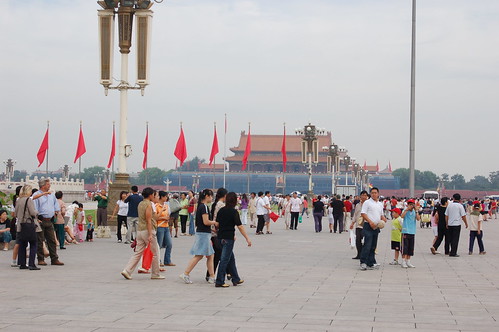
The New York Times (if you can't tell, my new favorite source of information...) has been running a series called Choking on Growth about China's industrialization and drive towards prosperity, highlighting the disastrous environmental and societal effects. The most recent part of the series focused on Beijing's attempts to clear its skies for the Olympics in '08. Despite their efforts, you can see Tiananmen Square in the photo to the right (courtesy of NYtimes.com, AP). For comparison, I attached my own photo from this past August to show it's not always so bad (though I did suffer through a couple of days this bad last January '07).

On a lighter note, Sexy Beijing is one of my new favorite things on the internet. A spin-off show from the acclaimed Danwei.org, a blog about media and news in China, Sexy Beijing is a series of Youtube-supported videos starring Anna Sophie Loewenberg in a show opening with an homage to Sexy in the City, but quickly turning into often interesting, usually hilarious street-side interviews. "Sufei" uses her language skills in Chinese, sometimes aided by friends, to penetrate some of the more curious aspects of love and life in everyone's favorite city--Beijing. It's really a great study break, but really opens up China, specifically Beijing, culture in a very tangible way. Don't pass this up.

Don't pass any of them up.

Sunday, October 14, 2007

Media

For any readers still making their way to this little place...I've yet to decide what the future will hold, but I would not say an occasional return would be without reward. In time there will be more photos from my time in China--film that I'm just now developing and printing. I might also find occasion to reflect on my time in China, or at least share with you some new finds that somehow pertain to my experiences recorded in this blog. This is one such occasion.

In the post China: The Musical I briefly described Beijing's exploding performance for the Chinese New Year. Jeremy, the director of my school in Hangzhou captured a similar experience there on camera--which I hope will give you some idea of what it was like. Keep in mind--that's all shot up from your average comrade.

In other news, I've come across a NYTimes article about Kunming called China Lite which describes it as a bastion of counter-culture that possesses a laid-back atmosphere not found elsewhere in the People's Lovely Republic. The places and events described in the article pretty much describe my life this summer.

Monday, August 20, 2007

Lists

So, my time left here in the People’s Lovely Republic is short. In these situations, I feel reflection is inevitable—an attempt to discern through the fog of time and emotion the moorings of fact and what will be memory. I’m also starting to think of the friends I know will be coming here themselves soon enough or even in the winter, to walk the same steps I have. I’ve found the best way to go about organizing things (for me at least) is lists. From lists, you can expand to points, and connecting points, you make arguments, manifestos, and revolution.

Things I will miss or have already started to miss about life in China:
-Chinese food, Chinese food, Chinese food
-music shows in Beijing (Jazz at D-22, seeing Iz, etc.)
-big group dinners in Beijing
-Laobian Jiaozi Restaurant—best Dongbei (Northeast-style cuisine, i.e. dumplings) restaurant ever…
-jidan Guan Bing (egg-pancakes sold by the old couple outside the gate of CET Beijing)
-the little convenience stores outside CET
-the Xinjiang food near CET
-group outings to Sanlitun’r (the bar street)
-warm bubble tea (zhenzhu naicha, ‘pearl milk tea’) in cold Hangzhou
-Lanzhou food: la mian (pulled noodles), potatoes and beef on rice, and jidan chaomian (egg with fried noodles)
-scotch and green tea (together)
-bottled green tea
-7 Club in Hangzhou—cozy little import beer bar
-the one Hangzhou Greentown soccer game I went to
-conversations on bus rides with classmates (usually about China or the people around us)
-times at the all-you-can-eat/drink Japanese restaurant in Hangzhou and our tours of West Lake afterwards
-nighttime jaunts around West Lake in general
-old people and their crazy dancing, exercising, and games
-exploring neighborhoods
-epic scenery/locations
-really smiley waitresses/store workers
-(usually) great service without having to tip
-my teachers
-a little village one mountain away from Tibet
-easy access to lots and lots of different kinds of tea
-being able to bend rules because I’m a foreigner
-the bit of unprostituted, undestroyed culture you might accidentally find somewhere
-making coffee with my French press
-75-cent DVDs
-drying my clothes on the line
-qiezi (Chinese eggplant in all its tender, gooey goodness)

Things I won’t miss:
-the staring, gawking, laowai-laowai-laowai-ing, walk-by Hello!s, and requested/unrequested photographs
-shop clerks hovering an inch behind me or trying to sell me everything I do and do not look at
-la duzi (“pulled stomach”—take a guess)
-being lectured to about my country/Chinese nationalism
-Chinese political/whatever slogans and other feihua (“nonsense”/"thief's talk")
-the ignorance—western and Chinese
-unrelenting and pervasive anti-Japanese mentality
-“cultural exchanges”—“Americans are all rich, right?”
-struggling with people who ignore my Chinese in order to speak their English—which no one understands, least of all me
-Hangzhou cabbies—may they rot in hell
-Chinese traffic/transportation impatience
-people of all shapes, sizes, and gender blowing snot-rockets and hocking their insides out everywhere
-everyone littering and the people whose job is to sweep the streets after them
-the prevalence chain-smokers
-being told my Chinese is great after I say Ni hao (Hello)
-never 100% understanding someone/never being 100% certain I spoke correctly
-seeing someone dead or dying with a group of people standing around them just watching
-people incapable of forming a line
-long fingernails
-women shielding themselves in any ridiculous way they can from the barest drop of sunlight that might touch (and darken) their skin
-Chinese train stations
-the Chinese tourism industry and its effect upon landmarks
-Chinese break-my-heart pop music
-Chinese "House" music
-white-tile buildings with blue windows
-squealing electric scooter brakes
-crossing streets

I guess that gives you an idea.

Tuesday, August 14, 2007

On a Theme

The track on the ‘soundtrack of my life’ for Summer ’07 would have to be the Rolling Stones’ “Beast of Burden.” I did not bring my music library with me to China, so my musical experience in China has been limited to what’s on my iPod. As you might imagine, the same old songs tend not to sustain 7 months’ listening. Thus sometime in the beginning weeks of my time in Kunming, I experimented with making a new playlist for my small musical companion. The theme of this new symphony of mine was intended to be a laid-back, feel-good background for a chill party perhaps, and I believe I’ve achieved this to some degree. And in the process of composing this playlist, I rediscovered “Beast of Burden,” which I can’t help but play to death.

And that laidback, feel-good, chill feeling I get when listening to “Beast of Burden” has really reflected the theme of my 9 weeks in Kunming. I read in the morning with my coffe; I pass the day in the office mixing work with breaks to read the New York Times; and I walk home through the cluttered streets, waving at the baozi-making family. Some days I ride a couple of buses to get some pulled-noodles and go climbing at the wall on the other side of town. Some days I hang around and watch DVDs like a lazy bum. I make peanut butter-and-jelly sandwiches when I want a snack; I get ice cream for the walk back to the office or home after meals; and I drink little cans of coconut juice/milk. I’ll tell them not to put chili peppers (lazhao) in my food (because they put it in everything there; eating is no longer the great refuge it once was), and it’ll be bad or good. I’ll eat out with coworkers or I won’t. I’ll head to the university area and chill with a book, or I’ll go with a coworker and have a beer; or I’ll do all the above—and often enough, I’ll be bobbing my head to “Beast of Burden” or another song on that list.

This summer I’ve missed home, friends, and Midd more than ever before in China—but on the whole, I’m relaxed. It’s different here from other places in I’ve been in China. Maybe it’s summer; maybe it’s a different culture; maybe it’s just different music. But it’s different here. I don’t think China’s for me—the work’s unrewarding, the day-to-day uncertain and damned dangerous, and the people are just walking in a different direction—we just don’t get each other. And that’s alright I guess. I’m alright with that.

It’s over soon enough, and I got it done.

Wednesday, July 4, 2007

Spring/Summer

It is only my third week in the Spring City, but I’ve already fallen into a routine that I believe was mostly settled my third day here: I wake up as the old ladies in the courtyard below finish their morning dancing; I read a page or two with a cup of Yunnan coffee; and I stop at the “baozi lady” to get my two sweet bean paste-filled Chinese pastries to breakfast on as I read over email and the morning’s (or should I say night’s?) headlines on the New York Times.

The end of my semester in Hangzhou proceeded without major event. It settled into the rhythms an iPod-accompanied walk between my dormroom and the various places I habited to eat, life’s reality sharing time with the fantasy provided by reading. Hangzhou provided time or at least an incentive not found at Middlebury to read for private entertainment, and I added to the aforementioned books Charles Frazier’s (author of Cold Mountain) highly anticipated sophomore work, Thirteen Moons; Gabriel Garcia Marquez’s One Hundred Years of Solitude; and am now close to finishing my rereading of Tolkien’s The Two Towers.

And so I came to the end of my time in Hangzhou. Most classmates (and I am no different), were just ready to get out. For some this meant home and loved ones, far away from the eccentricities of Chinese life. For others, it meant family or friend-accompanied travel. And for a fair number of others, it meant life moved to a new Chinese city or at least a new life in the same Chinese city for studying or working. I think everyone was confronting some form of disbelief. It seemed impossible that some of us would be home in a matter of days; that some would not be home for months; that some still had to languish through the added days and weeks of traveling when all they wanted was their own bed.

As I was just realizing that my time in Hangzhou would soon be over (what a week or two earlier seemed unending), I also realized that I had just passed the halfway point of my time in China. This discovery was aided by a time calculator on the internet, which also revealed to me that I had spent about 10 million seconds in China; another 10 million remained.

And so, for better or for worse, I moved to the wild west—Kunming, Yunnan—to begin my internship with The Nature Conservancy. But first, I decided I’d have a little vacation. Taking a day to relax and see a bit of the city with my supervisor and co-intern, I headed out with a 40 liter backpack to Northwest Yunnan: I went to see what the government calls “Shangri-La”—the corner of Yunnan nestled at the feet of the Himalayas. Once you get to Zhongdian (now officially Shangri-La, or Xianggelila in Chinese), you realize “Tibet” is not bound by the borders of the map. In fact northwestern Yunnan, western Sichuan, and Qinghai Province are all regions heavily-populated (heavily used here as a comparison, not suggesting density) by Tibetans—many nomadic.

In the course of a few days, I crawled my way by bus, taxi, and boot to Meili Snow Mountain (a range of snow-capped peaks on the border the maps draw between Yunnan and Tibet). There I spent some time in a small village nestled in a lush valley, meeting western and Chinese backpackers, drinking local grape wine, seeing a sacred waterfall, and enjoying both sun and storm. I can genuinely say it was one of the most beautiful places I’ve ever been and definitely one of my best experiences in China. I hiked down on a stormy, cloud-swallowed day, and we drove back to the nearest town on winding mountain roads listening to the driver’s cassette of Tibetan folk—a haunting music of women wailing in song and men underscoring with deep tones. I looked back, but the mountains and the world and our little van were all swallowed, hidden in cloud.

These short weeks in Kunming have so far been filled with exploration of its endearingly decayed infrastructure, settling into the routine of working 9-5, and finding ways of busying myself. The city feels very alive but relaxed, the old and young ambling or lazing along the streets. It is called the Spring City for its cool climate throughout the year and perhaps its bursts of rain throughout the day. To my amazement, though, it is more a rule than an exception that the day’s stormy weather will be spited by the sun breaking through at 5, parting the way for blue sky. 5 million more seconds till summer.

Sunday, May 27, 2007

All Quiet on the Eastern Front

I have been uninspired to write for a period of time. Nonetheless, a classmate has provided me with something that I hope should amuse some and provide insight to others:

There are two basic ways of ordering food in China. Try and guess which one I normally opt for.

Method One:

1. Enter restaurant. Listen to 16 waitresses shout " " down your ear.
2. Despite the fact that you have entered the restaurant by yourself, and there is nobody else near the establishment for another 15 miles, the waitress asks if you want a table for one.
3. Follow waitress to table. Wait five minutes while the waitress clears the mass of bones, spit, foetuses, lost scrolls, blood, and monkey claws from the table with an oily rag.
4. Place tissue paper on chair and sit down. Of the 27 waitresses who gather round your table, tell 26 of them to go away.
5. Within 0.00000000001 millisecond of sitting down, the waitress is hovering behind impatiently.
6. In impeccable Mandarin, ask for a menu. Repeat angrily when waitress giggles, looks away, and shouts to her colleagues that she doesn't understand English.
7. Tell waitress you don't want the most expensive items she is pointing to on the menu.
8. Tell the waitress to bring you a beer while waiting. When it arrives, send it back and ask for a cold one.
9. When the waitress asks if you would like to drink the beer opened or unopened, ask her to open it.
10. Choose meal.
11. Choose different meal when told they don't have it.
12. Repeat stages 10 and 11 about three times.
13. Finally choose something they have and ask them not to put any egg in it.
14. Relax. All the time, a million Chinese peasants are staring at you, spitting, and muttering: "laowailaowailaowailaowailaowai".
15. After 20 minutes ask what is happening with your meal.
16. After another 20 minutes receive meal, then send it back because it has egg in it.
17. Seven days after you entered the place, finally receive meal.
18. Pick out the stones and pubic hair.
19. Eat.
20. Halfway through your food, have your meal disturbed by the manager insisting on sitting down next to you and asking where you are from and if foreigners eat pork as well.
21. Ask to pay the bill, then tell them to check again after they give you the wrong bill.
22. Pay for meal. Waitress asks if you have the correct change which you do not. Wait another 15 minutes as she goes down the street to find change.
23. Leave when 16 waitresses shout " " at you. Waitress 17 will shout "Bye bye!" instead and everybody will find it hilarious.
24. Burn the place down. Then shit through the eye of a needle for two days afterwards.
25. Point 25? There is none.

OR

Method Two:

1. Walk into McDonalds/KFC.
2. Point at what you want.
3. Eat and get the hell out.


True more or less. I haven't given into McDonalds/KFC way of life yet, though. My solution is to go to the same 4 restaurants and alternate a handful of meals. Works for me.

Sunday, May 6, 2007

News from the Homefront

This is pretty great news that I just had to throw out. Last semester I was involved in the developing of MiddShift and am very proud to have been a part of it. It was really sad to leave just as things were getting going, but what can you do? This is really something to happy about though, so read on! And yes, I'm still in China.

To the College Community:

I am pleased to announce that, after reviewing a written proposal from the student organization MiddShift and supporting recommendations from senior administrators, the Middlebury College Board of Trustees has approved a plan for the College (Vermont campus) to become a carbon neutral institution by 2016.

MiddShift originally presented its carbon neutrality initiative to the board in February, and that meeting led to the formation of the Carbon Neutrality Advisory Group (CNAG). CNAG was comprised of students and administrators, and its role was to further develop a written proposal outlining the potential costs, risks, and organizational impact of achieving carbon neutrality over the next nine years.

The College plans to achieve carbon neutrality through a combination of efforts, including the 2008 completion of a biomass plant, which will be powered by wood chips; operational adjustments such as energy efficient lighting and facility upgrades; and — after all other economically feasible efforts to reduce carbon have been exhausted — the purchase of carbon offsets.

In a 2006 inventory, the College calculated its carbon emissions at 30,000 metric tons, derived as follows:

· use of fuel oil number six at 85 percent
· use of fuel oil number two at 2 percent
· college-related travel at 9 percent
· electricity at 3 percent
· landfill methane from waste disposal at 1 percent

Each and every one of us will share in the responsibility for reducing the campus’ carbon footprint, and I thank you all for your continued support, enthusiasm, and leadership in this important endeavor to reduce the emissions of carbon into our environment. I would like to extend my thanks especially to the students, faculty, and staff members who worked on the MiddShift proposal, and to those who have worked on many previous efforts to reduce carbon emissions on campus. It is you who made today’s Board vote and this major expression of leadership and responsibility by the College possible.

Ronald D. Liebowitz